The Right Adaptogen Stack for What You're Actually Trying to Fix
Quick Answer: There’s no single ‘best’ adaptogen — ashwagandha targets stress and sleep, rhodiola targets fatigue and focus, and stacking the wrong pair can cancel each other out. Match the herb to the actual symptom, not the hype.
You bought the adaptogen everyone was posting about. Two weeks in, nothing’s changed. That’s usually not a dud product — it’s a mismatch between what the herb does and what you actually needed it to do.

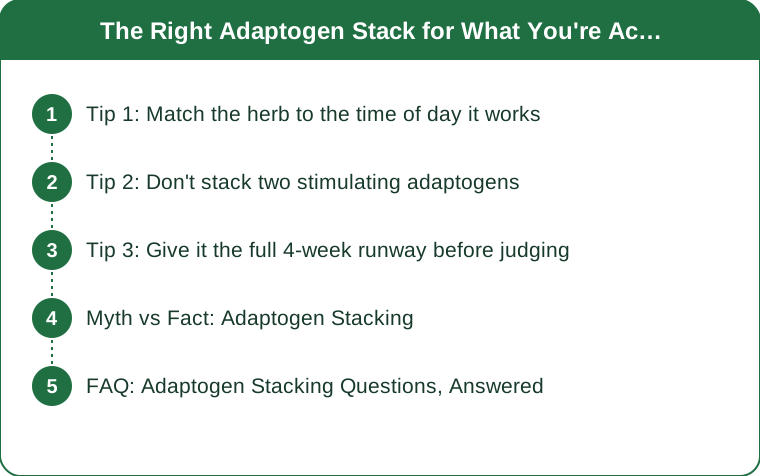
Tip 1: Match the herb to the time of day it works
Ashwagandha is a calming adaptogen — it lowers cortisol and works best taken in the evening, roughly 300-600mg, when the goal is winding down and sleeping deeper.
Rhodiola is stimulating — it’s built for mornings, typically 200-400mg before 2pm, because taken late it can genuinely disrupt sleep the same way caffeine would.
Tip 2: Don’t stack two stimulating adaptogens
Rhodiola and Siberian ginseng (eleuthero) are both stimulating adaptogens. Taking them together often just amplifies jitteriness rather than doubling benefits, because they’re competing for the same stress-response pathway.
A better stack pairs one calming herb with one stimulating herb, spaced 8+ hours apart, so each is doing a distinct job instead of overlapping.

Tip 3: Give it the full 4-week runway before judging
Adaptogens aren’t stimulants — they work by regulating the HPA axis over time, and most clinical trials measuring real effect run 4-8 weeks minimum. Judging at day 5 is judging too early.
Track one specific marker (sleep quality, afternoon energy, resting heart rate) rather than ‘do I feel different,’ since the changes are gradual enough to miss otherwise.
Myth vs Fact: Adaptogen Stacking
Myth: More adaptogens in one capsule means a stronger effect. Fact: Most ‘adaptogen blend’ products dose each herb below its studied threshold to fit multiple ingredients on one label — a single well-dosed herb usually outperforms a five-herb blend at sub-clinical doses.
Myth: Adaptogens work like caffeine, fast and obvious. Fact: They’re regulators, not stimulants — the honest experience is subtle and cumulative, closer to weeks than minutes.
Myth: If one adaptogen didn’t work, adaptogens don’t work for you. Fact: Wrong herb for the wrong symptom is the most common reason for a ‘no effect’ result — a stress-focused herb won’t fix low energy, and vice versa.
FAQ: Adaptogen Stacking Questions, Answered
Can you take ashwagandha and rhodiola together?
Yes — this is one of the more common and well-tolerated pairings, typically rhodiola in the morning and ashwagandha in the evening, covering both ends of the day.
How do you know if an adaptogen is actually working?
Look for a specific marker improving over 4+ weeks — falling asleep faster, fewer afternoon crashes, steadier mood — rather than an immediate feeling.
Is it safe to cycle adaptogens instead of taking them daily?
Many people do 8-12 weeks on, 2-4 weeks off, partly to avoid tolerance and partly because it makes it easier to notice whether the herb is actually doing anything.
TL;DR:
- Ashwagandha = calming, evening, stress/sleep. Rhodiola = stimulating, morning, fatigue/focus
- Don’t stack two stimulating adaptogens — they compete instead of adding up
- Give any adaptogen 4-8 weeks before judging it, and track one specific marker
- A single well-dosed herb usually beats a diluted multi-herb blend
Pick the one symptom you’re actually trying to fix, then match the herb and the time of day to it.
Keep Reading
This article is for general informational purposes only and is not medical advice. Always consult a qualified health professional for guidance specific to you.