5 Signs It Is Time to Cycle Off Your Adaptogen
Quick Answer: Most adaptogens work best in cycles of 8 to 12 weeks with a 2 to 4 week break, and your body usually signals the break before the calendar does. The five clearest signs are a fading effect at the same dose, flattened mood rather than calm, disrupted sleep timing, a return of afternoon crashes, and a growing sense that you need the supplement to feel normal.
You started it in spring and it worked. Now it is late August, the routine has not changed, and something feels slightly off in a way that is hard to name. That vague off feeling is the most common reason people quietly abandon a supplement that was doing its job - when a scheduled pause would have solved it.

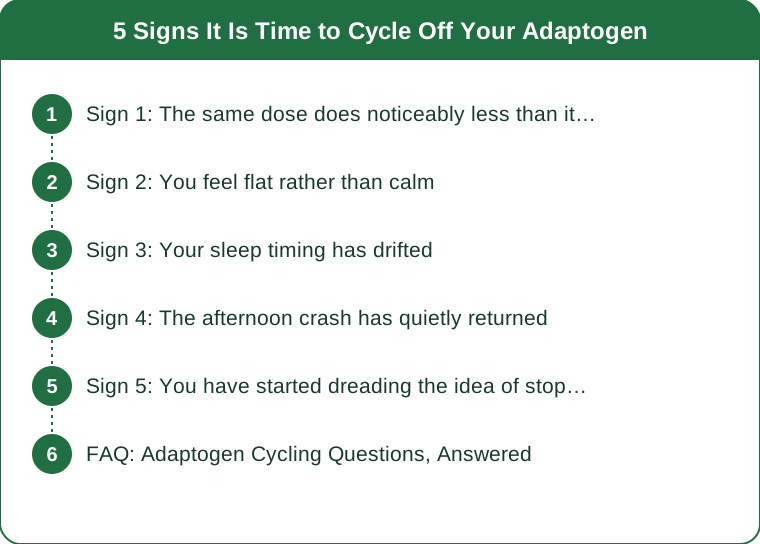
Sign 1: The same dose does noticeably less than it did
This is tolerance, and it is the most reliable signal. If a dose that clearly helped in week three does very little by week ten, your system has adjusted. That is normal physiology, not a bad product.
The instinct is to increase the dose. Resist it - raising the dose to chase a fading effect is how a 300 mg ashwagandha habit becomes a 900 mg one that works no better.
A 2 to 4 week break usually restores sensitivity to the original dose, which is both cheaper and safer than escalating.
Sign 2: You feel flat rather than calm
Calm and flat are different states, and the difference matters. Calm still has a full emotional range in it - you can be delighted, annoyed, moved. Flat is a narrowing where good news lands softly and nothing has much texture.
Adaptogens that blunt stress reactivity can, over long uninterrupted use, blunt more than intended in some people. Ashwagandha is the one most often described this way.
If friends or family have commented that you seem oddly unbothered by things that would normally register, treat that as external data and take the break.
Sign 3: Your sleep timing has drifted
Watch the timing rather than the quantity. Total hours can hold steady while sleep onset creeps later and wake time creeps earlier, which is a common pattern with stimulating adaptogens like rhodiola taken too late in the day.
Before assuming tolerance, move the dose earlier - rhodiola generally belongs before noon. If timing adjustments do not resolve the drift within a week, cycle off.
Late August makes this harder to read, since shortening daylight shifts sleep timing on its own. Give yourself a week of observation before concluding anything.

Sign 4: The afternoon crash has quietly returned
A returning crash at the same dose usually means the underlying stressor grew rather than the supplement failing. Adaptogens modulate a stress response; they do not manufacture recovery capacity out of nothing.
This is a genuinely useful signal because it points somewhere other than the supplement cabinet. Late-summer schedule changes, back-to-school logistics, and the first cool mornings pushing training earlier all raise the load.
Take the break, and use the break to look at sleep, protein intake, and how many hard training days landed in the last two weeks.
Sign 5: You have started dreading the idea of stopping
A supplement should be useful, not load-bearing. If the thought of a two-week pause produces real anxiety, that reaction is itself the reason to schedule one - and to schedule it in a low-stress stretch rather than the busiest week of the month.
Most people find the pause far less eventful than they expected. The first three or four days can feel slightly rougher, then it settles.
If a pause consistently produces symptoms beyond mild adjustment, that is worth raising with a clinician rather than solving alone. This is general information, not medical advice.
FAQ: Adaptogen Cycling Questions, Answered
How long should the break actually be?
Two to four weeks is the common range, and closer to four if you have been taking it continuously for more than three months. Shorter breaks often do not fully restore sensitivity.
Can I switch to a different adaptogen instead of stopping?
Sometimes, and this is a reasonable middle path - rotating between an energizing adaptogen and a calming one, for instance. But if the flat-affect sign is what prompted the change, take a true break rather than substituting.
Will I lose all the benefits during the break?
No. Benefits from consistent use are not erased in two weeks, and many people report the effect returning stronger afterward. If everything you gained disappears within days, that is worth examining with a professional.
TL;DR:
- Cycle in 8 to 12 week blocks with a 2 to 4 week break; the body usually signals before the calendar.
- Fading effect means tolerance - take a break rather than raising the dose.
- Flat mood is not the same as calm, and it is a stop signal.
- Dreading a pause is itself the clearest reason to schedule one.
Adaptogens work best treated as a seasonal tool rather than a permanent fixture, and late August is a natural point to reset before the fall schedule lands. Pick your pause window now while the calendar is still soft. This is general information, not medical advice - talk to a professional if you take medication or have a thyroid or autoimmune condition.
Keep Reading
This article is for general informational purposes only and is not medical advice. Always consult a qualified health professional for guidance specific to you.